SMS marketing pricing
Start on pay-as-you-go at $0.06 per SMS with no contract and no monthly plan fee (your number is $5 a month). When your monthly send volume makes bundled pricing worth it, you can move up to Basic, Pro, or Enterprise. You keep the same platform and the same TCPA compliance (the federal rules for marketing texts), at a lower rate per message.
Pay-as-you-go
No plan fee
Send what you need
Pay only for messages you actually send. Credits never expire.
Basic
1,000 SMS included
~$0.055 effective
For monthly programs with consistent send volume, with a lower per-message rate on extras.
Pro
5,000 SMS included
~$0.045 effective
For active campaign cycles, multi-event schedules, and retail programs with weekly sends.
Enterprise
20,000 SMS included
~$0.035 effective
For statewide races, businesses with several locations, and agencies running multiple programs.
Before you pick a tier
You start with 100 free SMS, and your number is $5 a month. Send one real campaign to a small list, check what it cost, and then choose a plan. You can move between plans later with a click, and mid-cycle upgrades are prorated (charged only for the rest of the cycle). If you are still deciding which features matter before you compare plans, the full feature breakdown covers what every plan includes.
| No surprise invoices
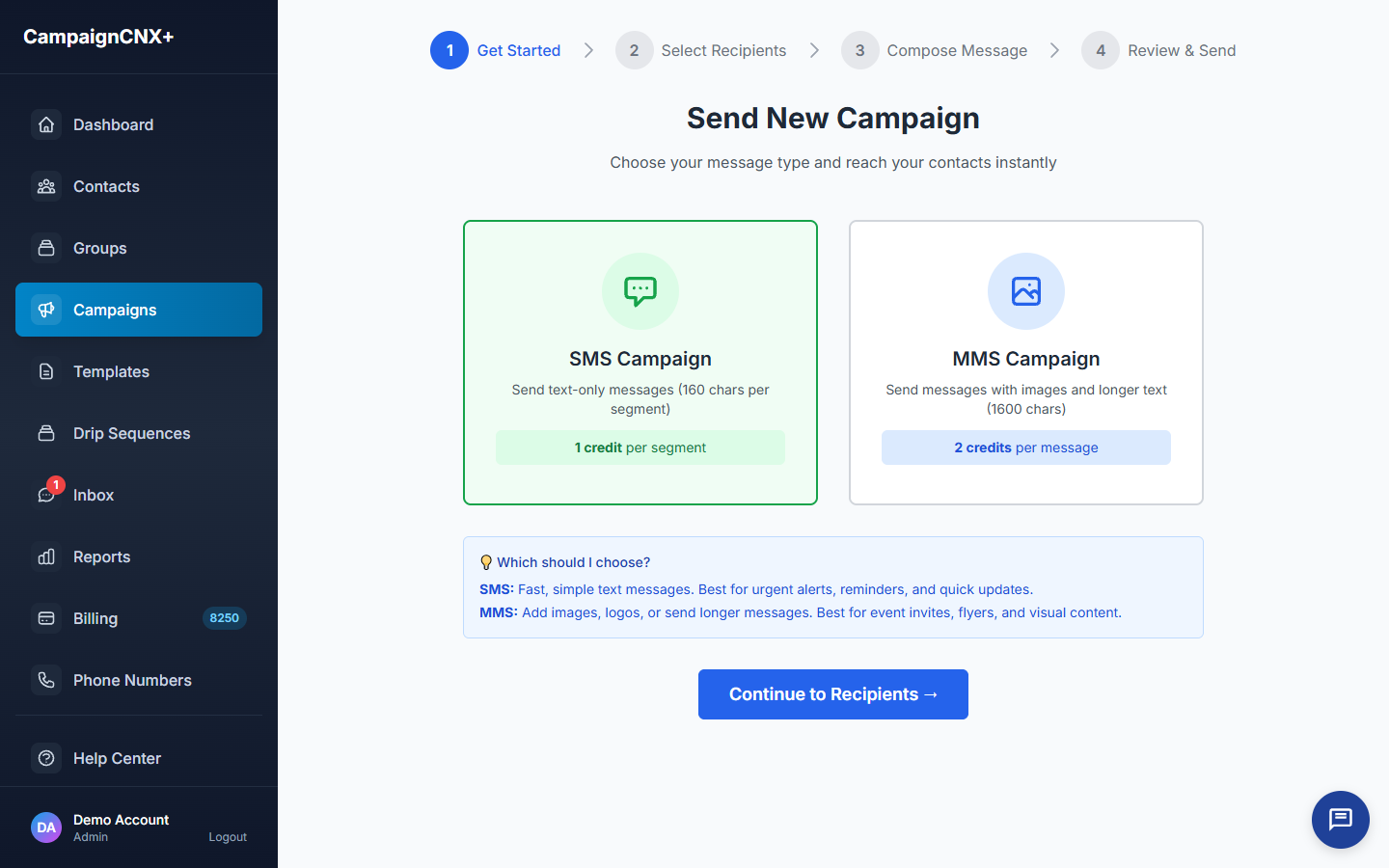
The review step counts segments (the units a text is billed in) and recipients, and it prices the campaign before it goes out, including any overage (messages beyond your plan's allowance). A message over 160 characters becomes two segments and costs twice as much, which is the most common reason a bill is higher than expected. The second most common is an emoji or a curly quote, which lowers the segment limit from 160 characters to 70. The composer shows both while you can still edit the message.
Add-ons
Add only what you use. Everything below is optional, and most accounts work well on the base plan alone. The add-ons people choose depend on the program. A campaign or committee usually adds keywords and a second line, while a multi-location business usually adds a line for each market.

What's included on every plan
/01
We honor STOP, UNSUBSCRIBE and the other opt-out replies across every campaign on the account, and answer HELP automatically. It is not a setting, so it cannot be switched off by mistake.
/02
We send only between 8 a.m. and 9 p.m. in each contact's own time zone, checked for each recipient at send time. A message to anyone outside that window waits until it opens.
/03
The composer checks for required opt-out language before it lets a campaign go out.
/04
We store where and when each contact opted in (gave consent to receive texts), and you can export message history as a CSV file if you ever need to produce it.
Two items are intentionally left off this list. DNC lookup is an add-on at $0.015 per number, which you run on import or before a campaign, not automatically on every send. 10DLC registration is a separate step, not a default. A toll-free number completes carrier verification in about three business days, and the carriers review your 10DLC registration at the same time while you send. The TCPA-compliant texting page explains what each of these does.
SMS pricing FAQ
We bill it separately, at $0.015 per number checked. It is not automatic on every send. You run it when you import contacts or before a campaign that needs it. After a contact is flagged, the flag stays on the record and the contact is left out of later campaigns. Every plan includes opt-out handling, quiet hours, STOP language validation, and the consent audit trail at no extra cost.
If you send fewer than about 900 SMS a month, stay on pay-as-you-go. Above about 900 messages a month, Basic costs less. Most campaigns with active schedules end up on Pro. Enterprise makes sense only above 15,000 SMS a month or when you need multiple team seats.
You can keep sending. There are no hard caps, and a send is never stopped partway through. Before each campaign goes out, you see the overage cost ("this campaign will use X overage messages at $Y"), and the total is billed at the end of your billing cycle. Overage messages are charged at your plan's own rate ($0.055 on Basic, $0.045 on Pro, $0.035 on Enterprise), not the pay-as-you-go rate.
Yes. You can move to a higher plan, a lower plan, or pay-as-you-go with no penalty and without speaking to sales. Upgrades made in the middle of a billing cycle are prorated.
The fastest way to start is with a toll-free number. You purchase the number and submit it for carrier verification, which Twilio reviews in about three business days. Full sending speed (the number of messages per second the carriers allow) is available in 3 to 5 business days. For serious programs, such as political operations, high-volume marketing, or any program that needs reliable long-term delivery, we recommend 10DLC registration, which has a one-time $75 fee from TCR (The Campaign Registry, which records 10DLC registrations). We handle it during setup, so you can send from your toll-free number while the carriers review it.
Pay-as-you-go credits never expire. On a monthly plan, unused included messages roll over to the next month.
An MMS (picture message) uses 3 message credits, so it costs $0.18 on pay-as-you-go, $0.165 on Basic, $0.135 on Pro and $0.105 on Enterprise. Messages with images or flyers count as MMS. A long text message without an image is sent as SMS and uses one credit for each segment.
A message stays one segment up to 160 characters, but only while every character is in the standard GSM-7 set (the basic character set that texts use by default). An emoji, a curly quote or apostrophe pasted out of Word or Google Docs, a long dash, or a single-character ellipsis switches the whole message to unicode, a larger character set in which a segment holds 70 characters instead of 160. A 100-character message with one emoji in it is two segments and is billed as two. Accented letters vary. For example, e-acute and n-tilde are free, but a-acute and c-cedilla are not. For this reason, the composer shows the change as you type. The limit drops to 70 and the counter says unicode, so you see the price change before you send rather than afterward. You can also paste a message into the SMS character counter before you start a campaign.
Yes. You receive 100 free messages when you sign up. Your number is $5 a month, and you can use the free texts after carrier approval, which takes about three business days for a toll-free number. That is enough for a real test send to a small list before you commit.
No contract to get out of
Credits never expire on pay-as-you-go, so an account that goes quiet between cycles keeps its unused credits. Basic pays for itself at around 900 messages a month, and you can work that out after a month of real sending instead of guessing beforehand.
Start sending
Pay-as-you-go is the right starting point for most accounts. Move to a monthly plan once you know your volume. Upgrades in the middle of a cycle are prorated, and downgrades take effect on the next cycle. We submit your 10DLC carrier registration, which supports reliable long-term delivery, at the same time, and you can send from your toll-free number while the carriers review it.