Political SMS for campaigns, PACs, and advocacy groups
A campaign can have the right message and still lose votes because nobody sent the polling-location reminder in time. CampaignCNX+ is a political text messaging platform built to send that reminder. It follows the TCPA (the federal Telephone Consumer Protection Act) and the rules of the phone carriers, such as AT&T, Verizon and T-Mobile. It keeps a full record of every message for the wrap report (the summary a campaign writes after the election), and it sends fast enough that a precinct captain can still raise turnout on Election Day.
The short definition
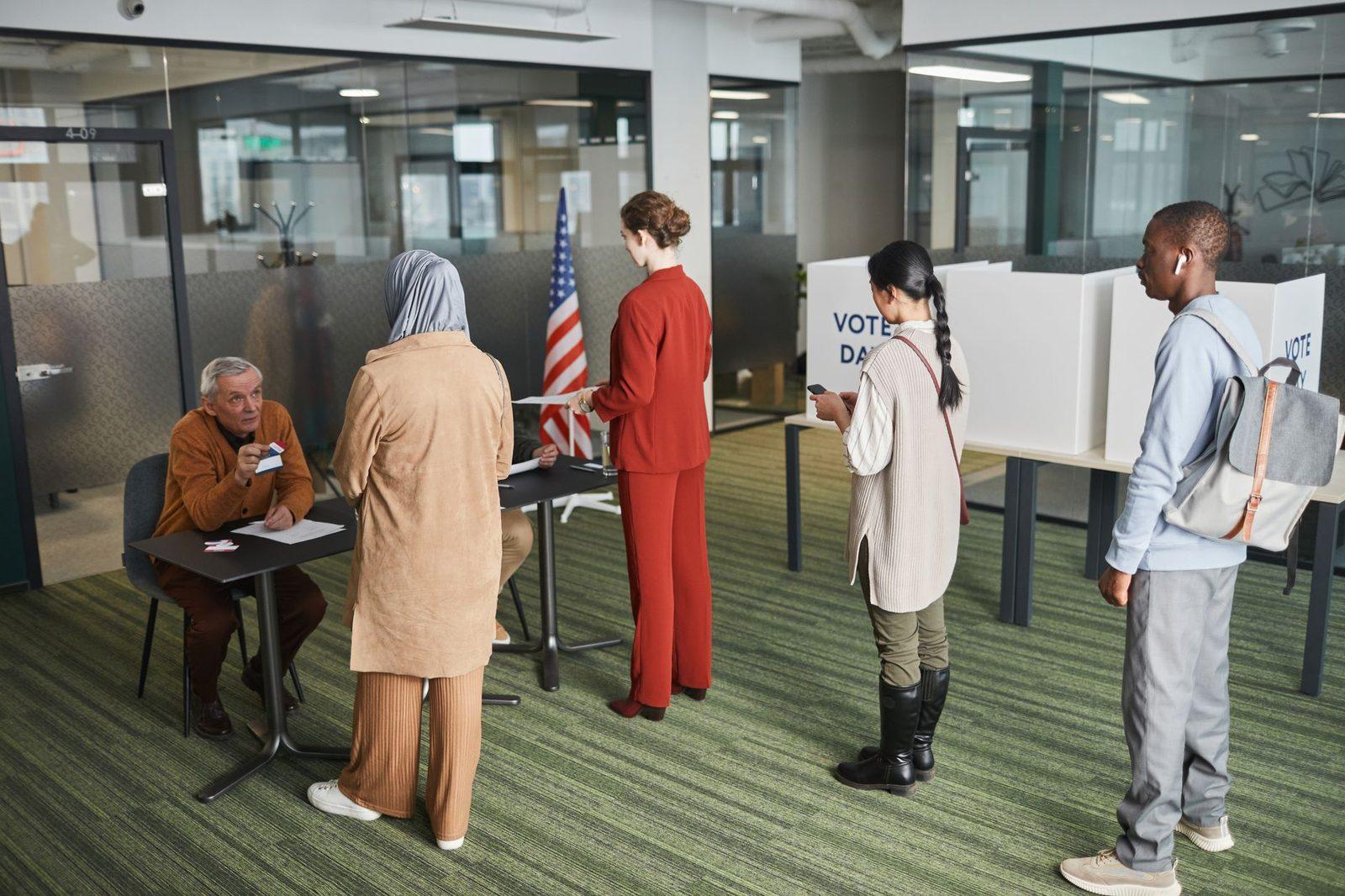
Political text messaging is voter contact by SMS (a standard text message) or MMS (a text message with an image), sent from a phone number your committee controls, to a list you can document. Rather than broad announcements, it carries the details that matter to one person at a time: their polling place, their shift time, their early-vote deadline, or a donation link they can use in a few seconds.
Campaigns send texts in two ways, and the difference matters more than the software you choose:
Texting does not replace door knocking, and it does not replace phone calls. It replaces the reminder calls a volunteer used to make from a list at 7 a.m. on Election Day, which often reached voicemail. A conversation at the door is how you persuade a voter. A text is how you confirm plans, send reminders, give directions and collect replies. Campaigns that send long persuasion messages by text get opt-outs (people replying STOP to leave the list), while campaigns that use texting for reminders and logistics get turnout.
For the planning behind all of this, the complete guide to political text messaging for campaigns takes a program from the first list to the final send.
What political campaigns send
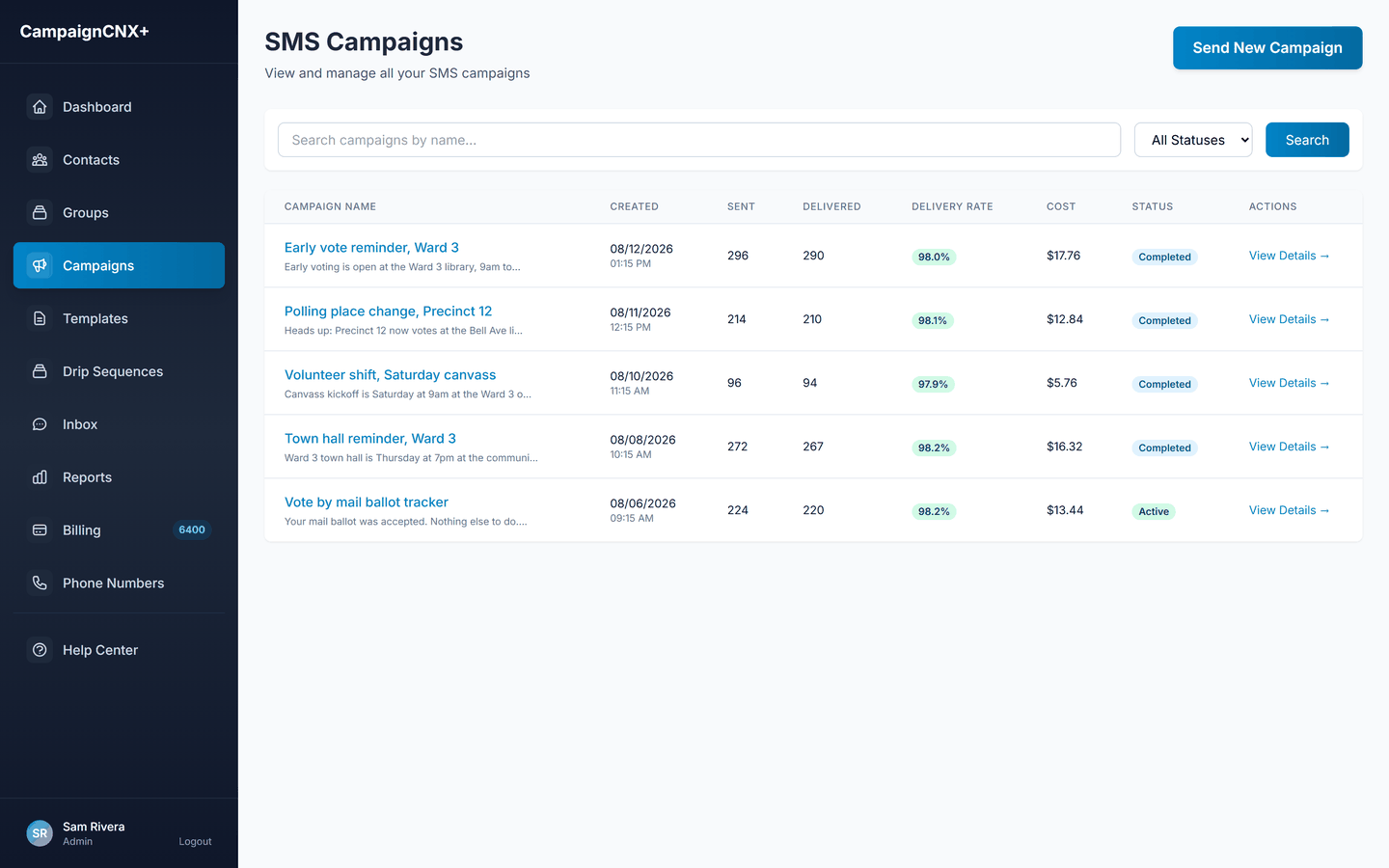
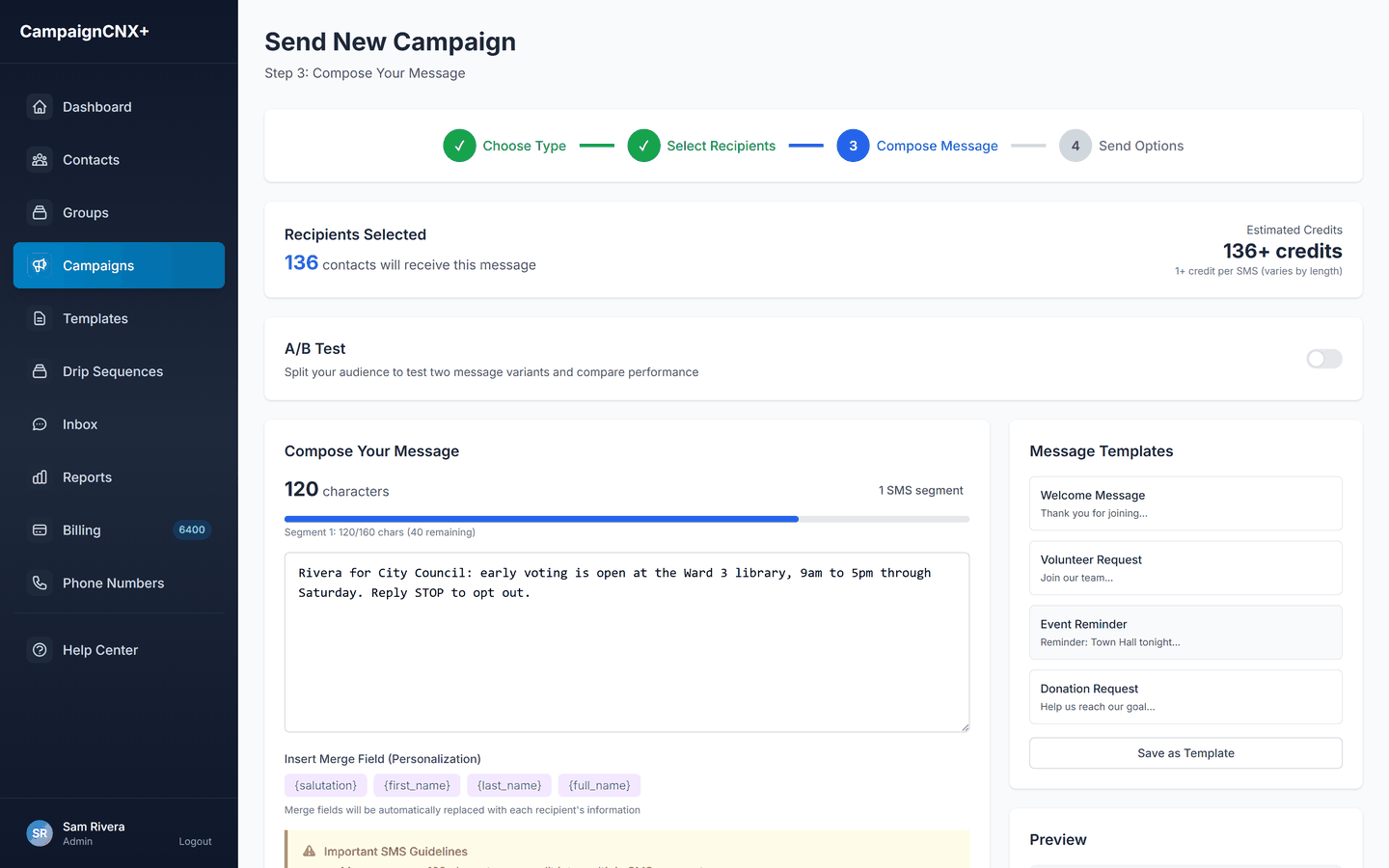
GOTV (getting out the vote), fundraising before finance deadlines, and volunteer coordination reach three different audiences. All three use the same four-step message composer and the same reports for the wrap report.
01: GOTV and voter outreach
Import the voter file, tag contacts by precinct, and schedule the message for 8 a.m. on Election Day. A merge field fills in each voter's own polling location. Quiet-hours rules keep the campaign inside the 8 a.m. to 9 p.m. local window, and anyone who has opted out is removed automatically when the message sends.
02: Fundraising and finance deadlines
Sort donors into groups by the size of their last gift, write the request with each donor's first name and a donation link, check the recipient count and total cost, and send. Delivery and reply rates update in real time as the messages go out during the Federal Election Commission (FEC) or state deadline window.
03: Field operations and volunteers
The volunteer list gets its own phone line. Reminders for Saturday-morning shifts can be scheduled to go out Friday at 6 p.m. When news breaks, you can send a quick response to a rally list without calling a planning meeting, and replies arrive in an inbox the field director can watch live.
New for 2026 · Political senders
In February 2026 the carriers began requiring 527 political organizations to hold a Campaign Verify authorization before political traffic is allowed on toll-free or short code. 10DLC has required it since 2021. It is not our rule and not our fee, there is no way around it for any vendor, and carriers can fine and block traffic sent without it.
Once your token is issued, that is the end of your paperwork. We file the carrier registration, submit the verification, and tell you when the number is live, usually about three business days after that.
Start sending
Open the account, choose a toll-free number, and load the volunteer roster this afternoon. Carrier review of a new toll-free number takes about three business days. You start with 100 free SMS, and your number is $5 a month.
Timing
A common mistake is to treat texting as a GOTV tool that is switched on two weeks before the election. By then you have no list, no record of consent, and no history with the carriers as a trusted sender. The texting program should follow the same calendar as the campaign itself. It runs in six phases, and each phase has a different purpose.
Municipal races on an April cycle compress all of this into about ten weeks, which is why the registration and list-building work has to start the fall before. A school board or city council campaign that opens an account in March is not going to have a usable list by the first week of April.
Every phase above depends on dates your state sets, not dates you choose, so it is worth building the calendar state by state. For committees working the Illinois cycle, our breakdown of the Illinois political texting calendar maps these phases onto the state's early-vote window, mail-ballot deadlines, and consolidated-election schedule. For a committee working several states at once, Midwest regional text messaging covers the twelve states in the region and the three time zones a regional message has to be scheduled around.

The message itself
The composer counts segments as you type. A segment is the unit a text is billed in: 160 characters in the first, 153 in each one after, and every segment bills as a message. This limit affects both cost and writing, and the effect on writing is the more useful one. A text that needs three segments is usually trying to say too much.
Every political text should include four things, usually in this order:
Tone matters more in a text than in almost any other channel, because the recipient did not ask to be persuaded at 8 a.m. Write the way a person on the campaign would write, not the way a campaign mailer reads. If you want example messages for voter identification, persuasion, mobilization, and GOTV, the collection of voter outreach SMS examples and templates has drafts you can adapt instead of starting from a blank screen.

Test the message
You start with 100 free SMS, and your number is $5 a month. That is enough to catch a broken merge field on the staff list before six thousand voters see it.
| Voter file and data
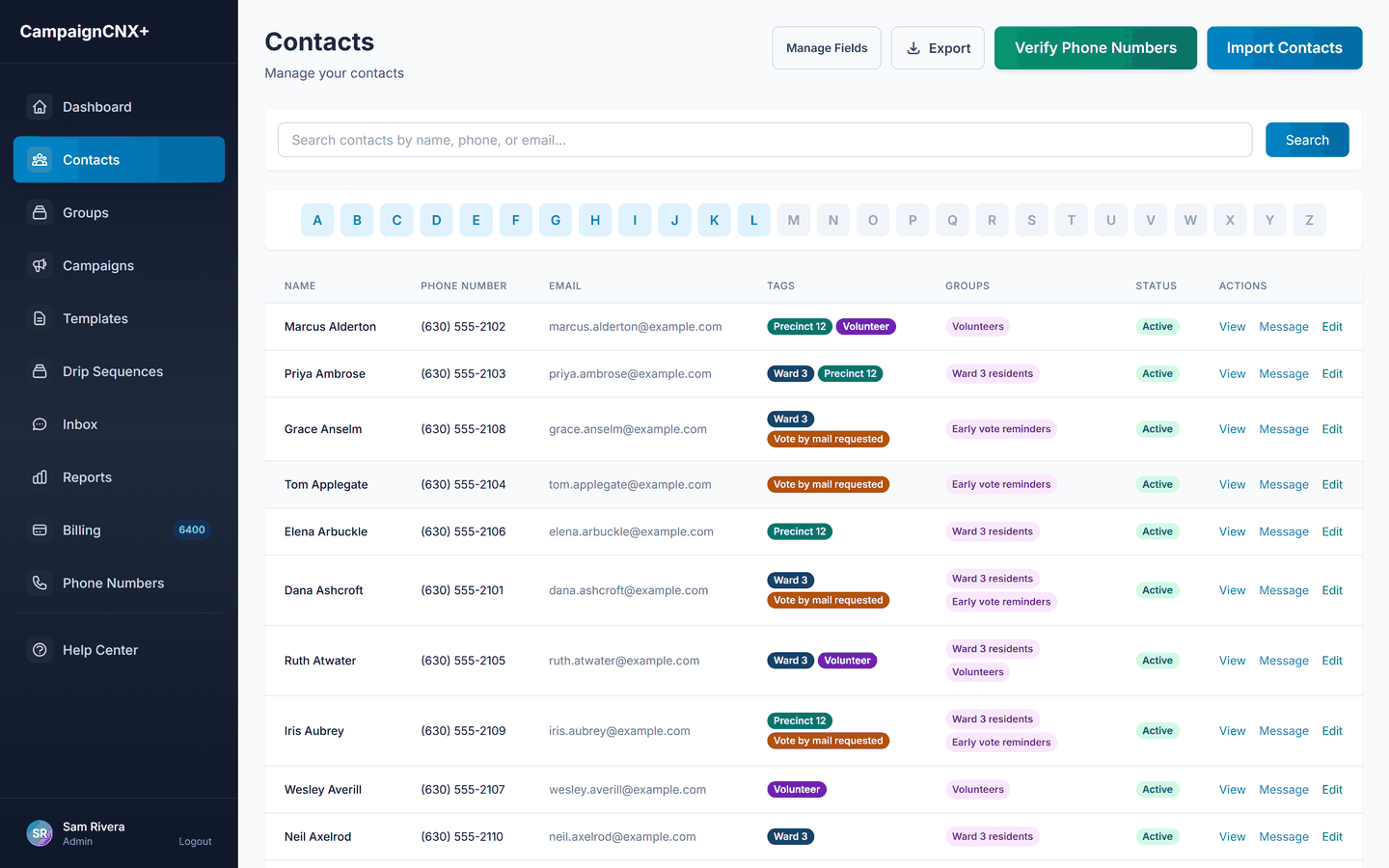
The voter file is the core of the campaign's data. It usually arrives as a CSV spreadsheet with forty columns you do not need and three you cannot run a program without. During import, you match your columns to contact fields, and any column that does not match a standard field becomes a custom field you can sort by later. Precinct, ward, support score, vote history, turf (the area assigned to a canvasser), and ballot status all come in as fields you can use to choose who receives a message.
Two data steps are worth running before the first message, because both cost less than a bad send. Phone append fills in missing cell numbers at $0.015 per lookup. A DNC scrub checks the list against the federal Do Not Call registry at $0.015 per check. Once a contact is flagged, the flag stays, and the contact is left out of every future campaign automatically.
One caution applies no matter which software you use. A cell number on a voter file is a public record, not consent. The file tells you the number exists. It does not tell you the voter agreed to receive automated messages from your committee. Campaigns handle that gap in one of two ways, either by building an opt-in list deliberately from the day they file, or by sending to unmatched numbers through peer-to-peer texting, where a person sends each message. Which approach applies to you is a question for your compliance counsel, and it should be settled before the data is loaded, not after the first complaint.
Campaigns often spend too little time on tagging and regret it in the last week. When contacts are tagged by precinct and ballot status, a message like "your polling place is Lincoln Elementary and it closes at 7" is simple to set up. Without tags, someone has to build those groups by hand at 11 p.m. the night before Election Day.
Political programs we support
The same political text messaging tools work for races of every size. A coordinated campaign and an independent expenditure group (a group that spends on a race but must stay independent of the candidate) can each run a separate 10DLC phone line under one billing account.
Congressional races, state house races, mayoral races, and school board seats all follow the same calendar: a primary push, a general election push, and a GOTV period. The platform supports every part of it.
Keep a supporter list engaged through a legislative session or a full election cycle on the same platform, with separate programs and separate phone lines under one billing account.
Committee structure
A coordinated campaign texting its own supporter list and an independent expenditure group texting a persuasion universe are two different programs in two different legal positions. They should never share a phone number, a contact list, or a sender identity. Suppose a voter gets similar messages from the same number about the same race, once from the candidate and once from a group legally required to be independent of that candidate. That voter is likely to file a complaint.
The practical separation looks like this:
The platform keeps the programs separate and keeps an audit trail. It does not give you a legal opinion on the firewall (the required separation between the two groups); that stays with your compliance counsel. The same setup works for a state party running several candidate programs, or an agency serving several clients, without the lists ever mixing.

TCPA for political SMS
/01
Run an optional federal DNC check during import. Political messaging has narrower exemptions than marketing, so verify before you send, not after.
/02
We filter opt-outs automatically across every campaign on the account, and we validate STOP language before a campaign can leave the review screen.
/03
Carrier approval of a toll-free number takes about 3 business days, and we file it for you. 10DLC is the recommended path for serious programs. We submit it at the same time, and you can send from your toll-free number while the carriers review it.
/04
Send windows follow each contact's time zone, so a schedule set in Eastern won't reach your California precincts at 5 a.m.
Register early
Quiet hours, STOP handling, and optional DNC lookup apply to every message, starting with the first one you send. You start with 100 free SMS, and your number is $5 a month.
| Disclaimers and reporting
Political texts fall under two sets of rules at once. Consent and opt-outs fall under the TCPA and carrier policy. Attribution (stating who paid for the message) and reporting fall under campaign finance law, which campaign managers often forget until the treasurer asks a question three days before a filing deadline.
On attribution: federal disclaimer rules cover public communications, and they include exceptions for items where a full disclaimer is impracticable given the size of the medium. Whether a given text needs a full "Paid for by" line, a shortened attribution, or a link to a page carrying the full statement is a question for your counsel, and the answer has changed as texting has changed. State rules are separate and some are stricter than federal, so call your state board of elections before the first send, not after.
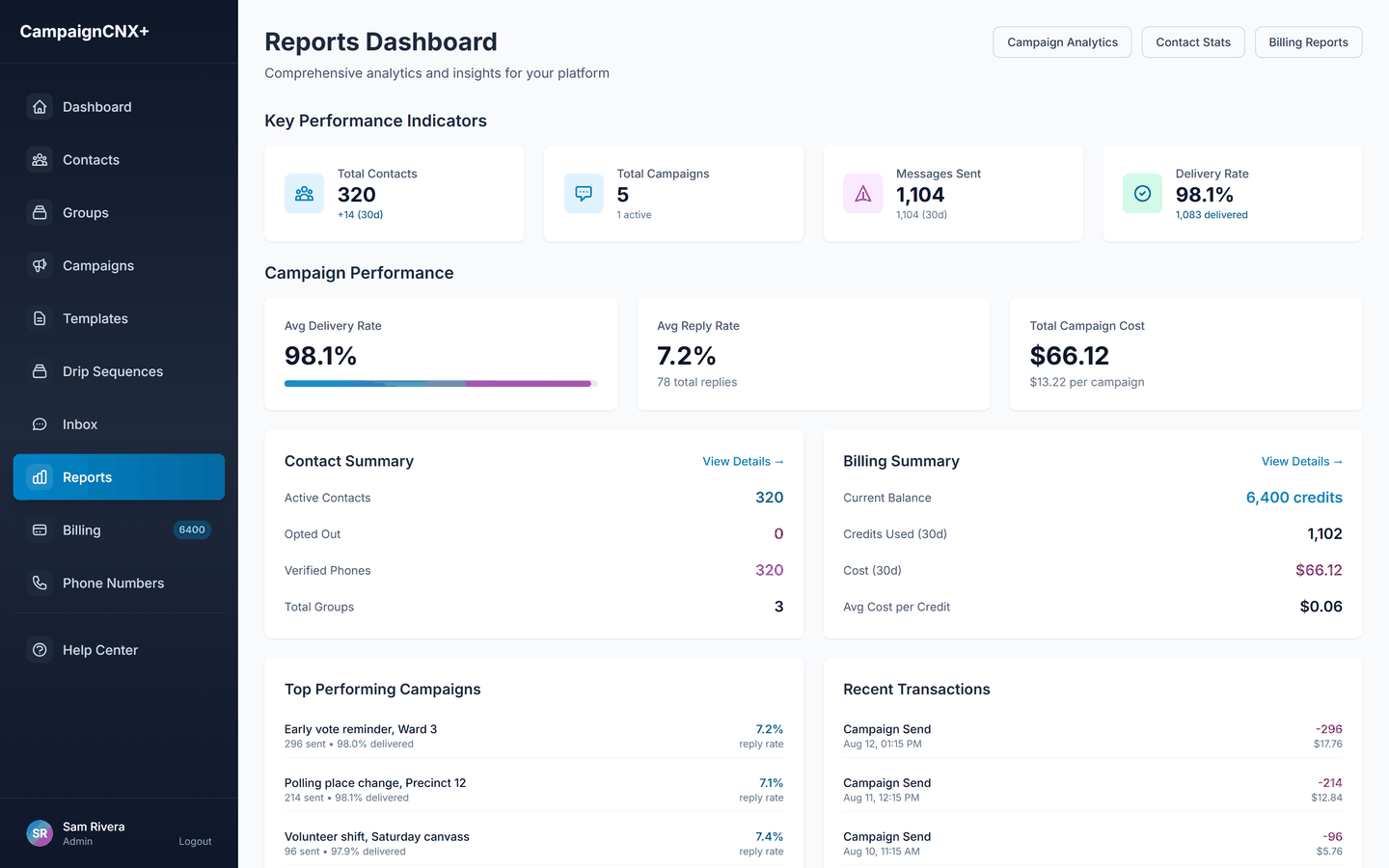
On reporting: money spent on texting is an operating expenditure paid to a vendor, and it is itemized like any other disbursement. What the treasurer needs is the invoice history and the cost breakdown for each campaign, and both export as CSV files.
The compliance rules that apply specifically to political senders are worth reading in full before you set up how your program collects sign-ups, because collecting consent is the one part no platform can fix for you after the fact. Our TCPA checklist for compliant political SMS campaigns goes item by item through consent, message content, opt-out handling, timing, and the technical requirements. For how the platform applies those rules to every message it sends, see the TCPA-compliant texting page.
The last three days
The last three days are the only window in which a text message changes a vote count, and by then there is no time left to fix a broken merge field. Schedule your messages before Friday.
Write every message for the remaining three days, test it on a staff list, and schedule it. Spot-check the polling-place merge fields against the county file, precinct by precinct.
Voters who requested a mail ballot and have not returned it are the most valuable group to contact. Send them one message with one deadline and one drop-box location.
Ask voters when and how they will vote, not whether they will. A voter who answers a question about timing is measurably more likely to vote. Replies arrive in the inbox, where the field director can see them live.
Send a 8 a.m. location reminder, a midday message to the precincts where turnout is behind, and a closing-time message based on what the reports about lines say at 5 p.m.
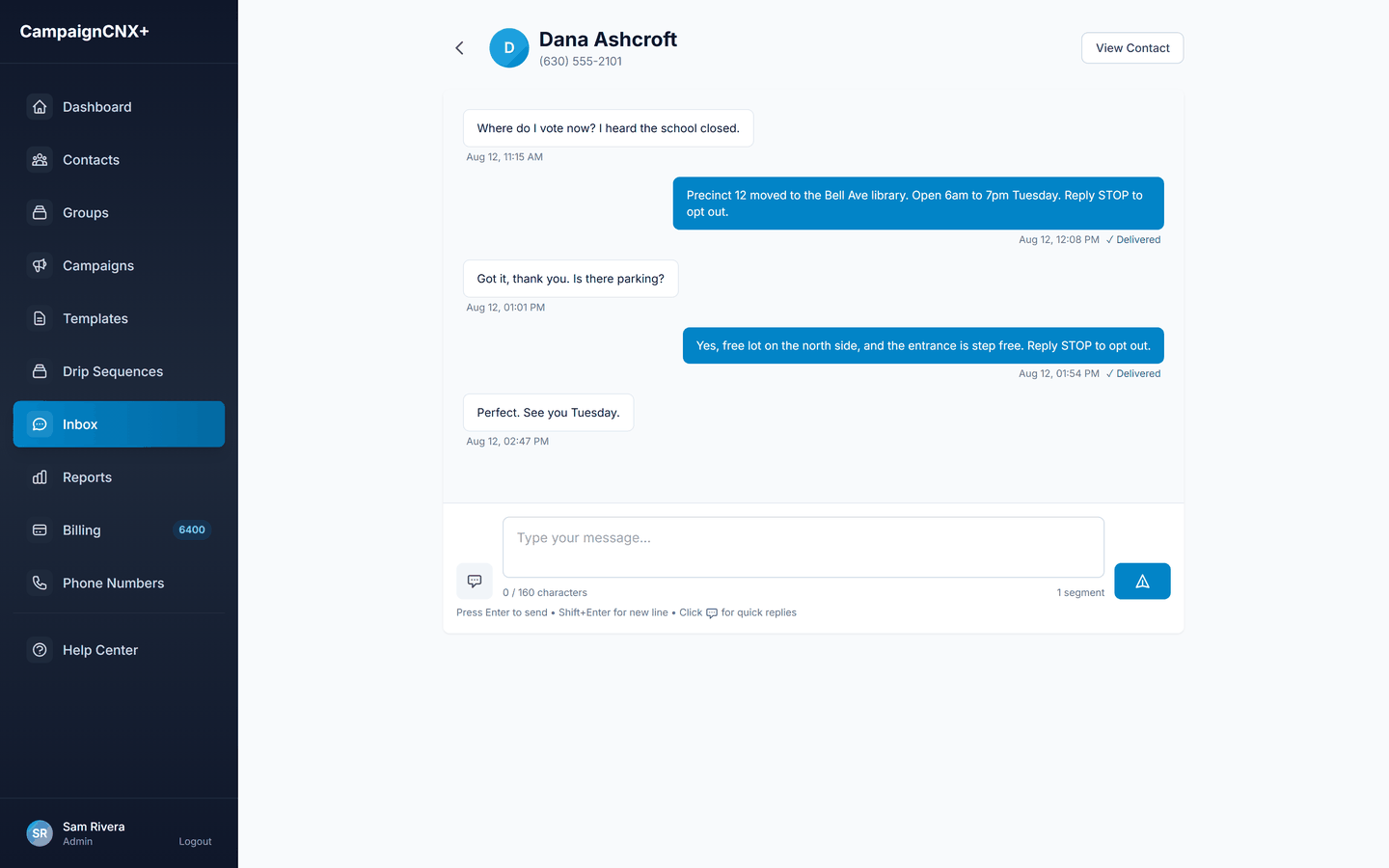
Two things decide whether this works. The first is to have people answering the inbox. A GOTV message brings real replies (wrong address, moved, already voted, take my name off), and those replies give you free turnout information and help keep your list accurate, which is what two-way texting is for. The second is to keep one message in reserve. Something unexpected usually happens on Election Day, such as a polling place moving, a three-hour line, or a court extending voting. A campaign that saved room for one unplanned message is able to respond.

Budget
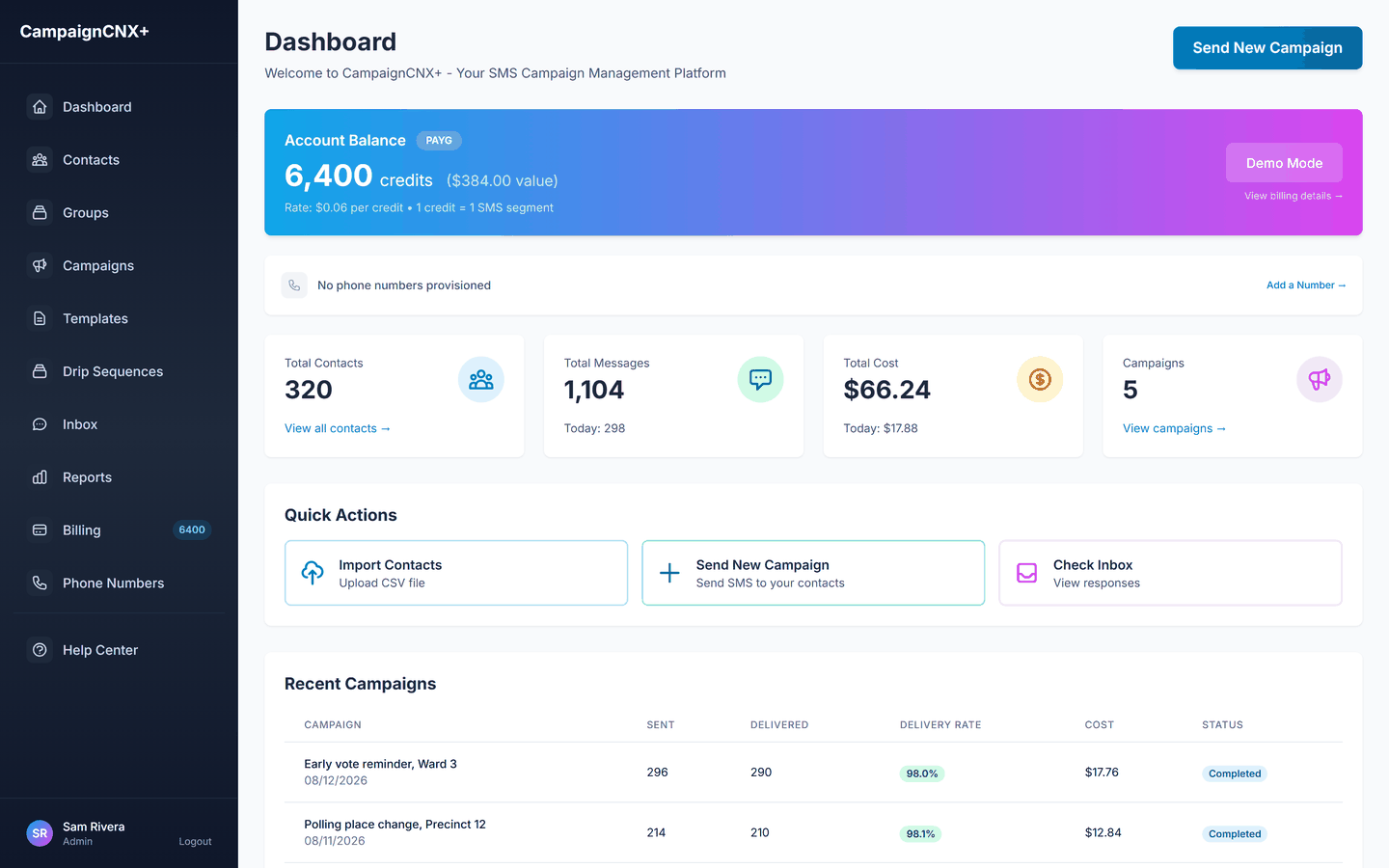
Pricing is public and there is no contract. Pay-as-you-go is $0.06 per SMS and $0.18 per MMS with no monthly plan fee. Plans bundle volume and lower the rate: Basic at $55 a month with 1,000 included, Pro at $225 with 5,000 included and $0.045 overage, Enterprise at $695 with 20,000 included, $0.035 overage, two-way included, and five team seats. Phone lines are $5 a month. Data lookups are $0.015 each.
Here is an example with a realistic list: 6,000 targeted voters, each contacted five times across the last three weeks, for a total of 30,000 messages.
Message length changes this budget more than the choice of plan does. A 190-character message bills as two segments, so the same 30,000-contact program becomes 60,000 messages and the cost doubles. Cutting three words from a GOTV text can be worth more than any volume discount on the page. MMS works the same way at a higher rate: three credits per contact, so use it only when the image is essential to the message.
A more useful question than what a single text costs is what it costs to gain one additional vote. Texting is worth the money for reminders and confirmations but not for persuasion, which is why the programs with the best return spend almost the whole SMS budget in the early-vote and GOTV periods. Full plan comparison and add-on rates are on the pricing page. For a smaller universe, what it costs to text a local race works through the same math for a library board, a village trustee and a Chicago ward race.
Price the program
Plan rates, overage, and add-on pricing are public and there is no contract. Start with 100 free SMS (your number is $5 a month), then move to a plan when your volume grows.
The day after
Most campaigns do nothing with the list after the results come in and then rebuild it from scratch two years later, which is the single most expensive habit in political data.
What to do in the first week:
For committees that keep operating between cycles (an advocacy program, a county party, a PAC with a legislative agenda), keep the account active on a lower-priced plan and send once or twice a quarter. People who hear from you occasionally tend to stay engaged. People who hear nothing for eighteen months and then receive a sudden fundraising message tend to opt out.
Step-by-step plan
If you are starting from nothing, follow this order. You can complete steps one through four in an afternoon. Step five is the one campaigns most often skip, and they pay for it later.
Field operations, walk lists (the lists of homes a canvasser visits), and turf assignment are handled in Beacon, our field product, not here. This platform handles the messages, and dividing up canvassing areas belongs in that separate tool.
Political SMS FAQ
Political SMS is covered by the TCPA: non-exempt automated texts to cell phones require prior express consent, regardless of message purpose. The platform enforces the rules that apply: STOP/HELP/UNSUBSCRIBE at the account level, quiet-hours windows, and optional federal DNC lookup on import. Campaigns are still responsible for collecting consent when people sign up.
Carrier review of a new toll-free number takes about 3 business days. Full sending speed is available in 3 to 5 business days. For a serious program (a competitive primary, a statewide race, a long-term PAC), 10DLC registration (a local number registered with the carriers for campaign texting) is the recommended path. We submit it at the same time, and you can send from your toll-free number while the carriers review it.
Yes, on separate 10DLC phone lines ($5/mo each), with separate contact lists, reports, and billing line items. Team seats control who can see each program. Questions about the legal firewall between the two stay with your compliance staff.
The platform handles enough volume for a statewide GOTV effort. Most campaigns of that size choose the Enterprise plan: 20,000 included SMS, $0.035 overage, two-way messaging included, five team seats. Pro handles most competitive races at 5,000 included SMS with $0.045 overage.
Reports show delivery rate, reply rate, opt-out rate, and cost per campaign, and totals for each program add up across the whole election cycle. You can export it all as CSV for the post-election memo.
The trial includes 100 free SMS, and your number is $5 a month. That is enough to run a live send to a staff or steering-committee list before you commit a voter file to it.
A cell number on a voter file is a public record, not consent. The file confirms the number exists; it does not establish that the voter agreed to receive automated messages from your committee. Campaigns close that gap either by building an opt-in list deliberately from filing day forward, or by sending to unmatched numbers through peer-to-peer texting, where a person sends each message. Which approach applies to you is a decision for your compliance counsel, and it should be made before the data is loaded.
Federal disclaimer rules cover public communications and include exceptions where a full disclaimer is impracticable given the size of the medium, which is why practice on SMS varies. Some committees include a short attribution in the message, and others link to a page that carries the full statement. State attribution rules are separate and several states are stricter than federal. Ask your counsel and your state board of elections before the first send, not after a complaint.
Work from message count, not contact count. A list of 6,000 voters contacted five times is 30,000 messages: $1,800 on pay-as-you-go at $0.06, or about $1,045 on Enterprise once the 20,000 included messages and $0.035 overage are applied. That works out to roughly 17 cents per voter for the full program of five messages per voter. Message length moves that number more than the plan does, because anything past 160 characters bills as two segments.
Export the message history, consent records, and per-campaign costs for the wrap report. Keep the opt-out list permanently; it stays flagged on the account and is more valuable than the contact list. If the committee keeps operating between cycles, send once or twice a quarter to keep the list active. If the organization changes (a candidate committee handing a file to a PAC or an advocacy group), the consent question reopens and should be treated as a new program.
Start sending
Start with a toll-free number. Purchase a verified phone number, import your voter file export or volunteer roster, and send your first GOTV or volunteer reminder once carrier verification is complete, which takes about 3 business days. For political programs running through Election Day, 10DLC carrier registration is the recommended path so your messages keep reaching people's phones over the long term. We submit it at the same time, and you can send from your toll-free number while the carriers review it.