Text messaging across the 12-state Midwest
A statewide program runs on one clock, but a regional one does not. The Midwest stretches from Ohio to the western edge of the Dakotas, so a message scheduled for 8:05 in the morning on the eastern end arrives at 6:05 in the morning on the western end. That is inside quiet hours, so it does not go out. This page explains how to schedule around that gap instead of discovering it afterward.
The regional constraint
The Midwest as the Census Bureau defines it is twelve states: Illinois, Indiana, Iowa, Kansas, Michigan, Minnesota, Missouri, Nebraska, North Dakota, Ohio, South Dakota, and Wisconsin. Three time zones run through them.
Four states are split between Central and Mountain time, two more are split between Eastern and Central time, and Illinois is one of the few entirely in a single zone. That detail matters as soon as you schedule a message.
Quiet hours run 8:00 a.m. to 9:00 p.m. in the local time of the recipient, not the sender. When you work out the times, the shared window is shorter. The earliest moment every contact is inside their own window is 8:00 a.m. Mountain, which is 10:00 a.m. Eastern. The latest is 9:00 p.m. Eastern, which is 7:00 p.m. Mountain. A single message sent to the whole Midwest at once has eleven usable hours, not the thirteen a single-state program gets. The width of the region uses up two hours of the day.
If you send outside that window, you will not see an error. Messages to Mountain-time contacts are held until their window opens. That is the correct behavior, but it is also why a regional send can look complete in the report while arriving hours late in the west. The solution is to schedule each time zone separately. The main political text messaging platform page explains how to build a program like this, phase by phase. This page covers what changes once you cross a state line.
How to build a multi-state send
You do not need three accounts, three lists, or three bills. You only need a time zone field you can filter by.
01: Import
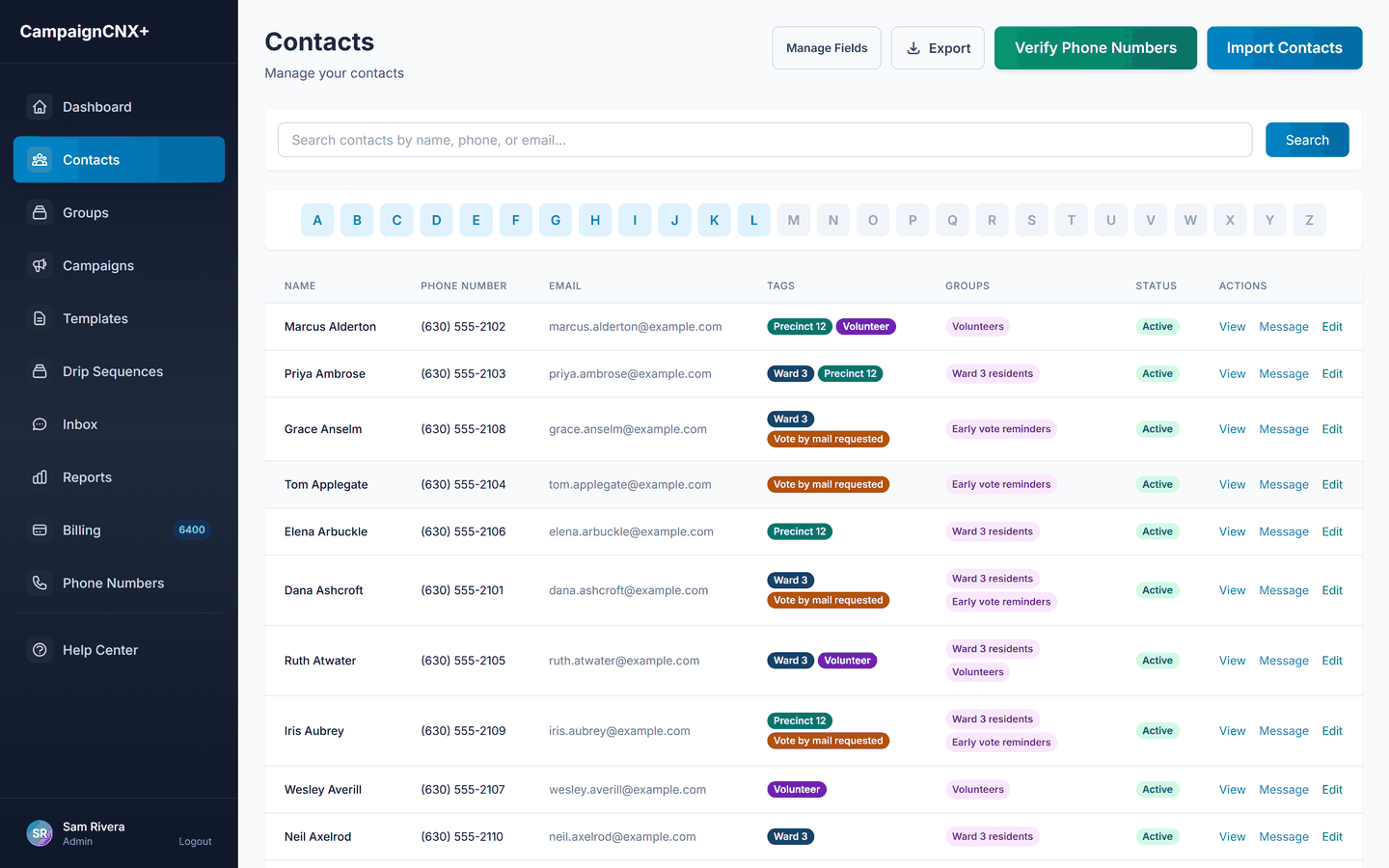
Every contact record stores a time zone along with the consent source and opt-in timestamp. We enforce quiet hours based on that time zone when each message sends, so a Nebraska number that moved to Cincinnati is handled correctly without anyone having to notice. Import state, county, and metro area at the same time, because those are the groups you will send to.
02: Schedule
If a message should arrive at 8:05 in the morning, it should arrive at 8:05 everywhere. Set up the same campaign three times, filtered to Eastern, Central, and Mountain contacts, and schedule each one for its own local hour. The first and last sends go out two hours apart, and everyone gets the message at the local time you intended.
03: Review
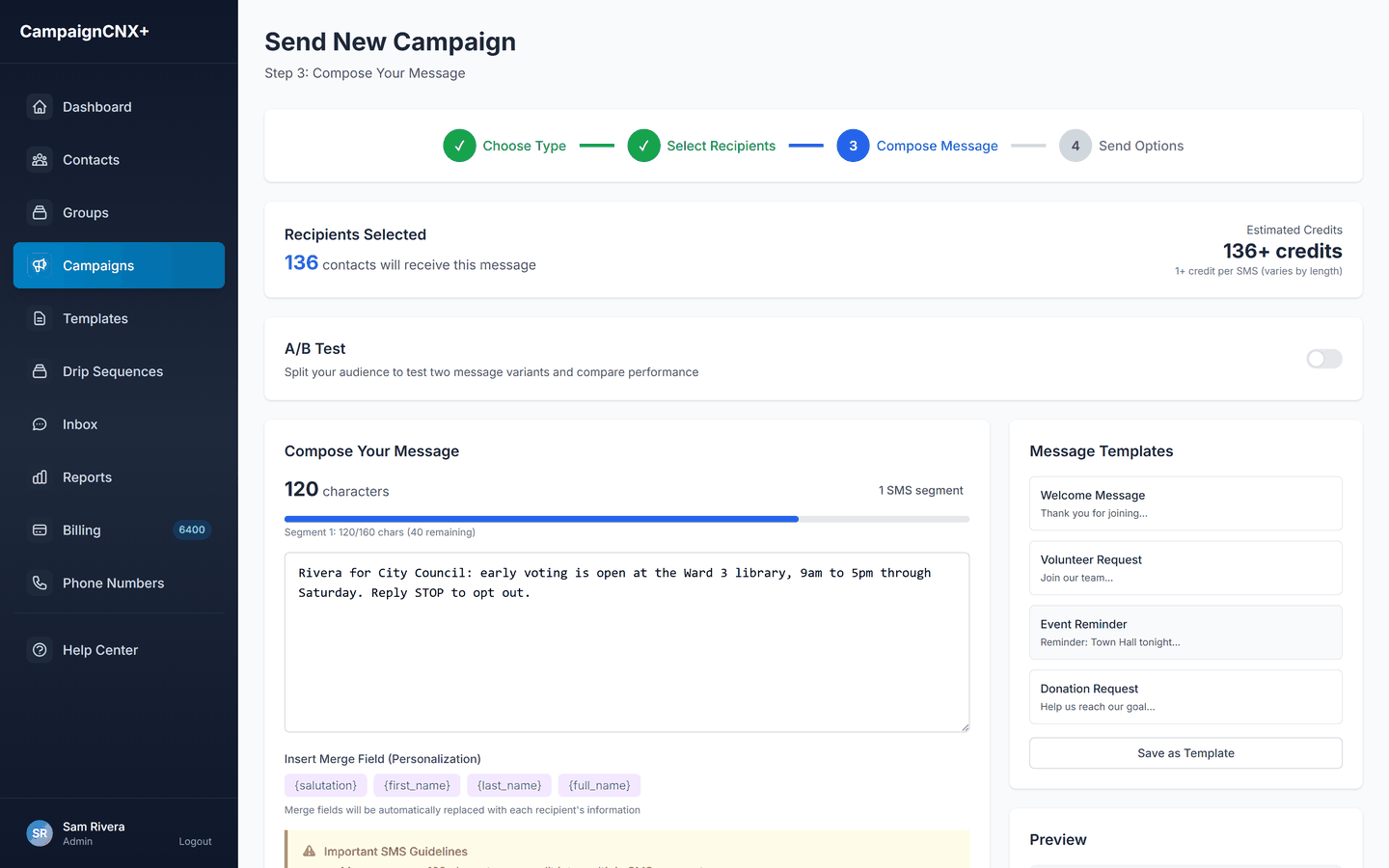
An area code shows where a number was originally assigned, not where the person is now, and in this region it is wrong often enough to matter. Someone in Rapid City may have kept a Sioux Falls number, and an Indiana number may be on either side of the line. The review screen shows the recipient count and cost for each scheduled send. That makes it the last inexpensive point to notice, for example, that your Mountain group has eleven people in it and does not need its own send.
Try the schedule
Load twenty people across three states and see how quiet hours hold each message until the local window opens. The trial includes 100 free SMS with no monthly plan fee, and your number is $5 a month.
Committees, state parties, and advocacy organizations
The 2026 federal general election is Tuesday, November 3, 2026, nationwide, the Tuesday after the first Monday in November. That is the one date a regional program can plan against without checking anything.
Everything else is set by each state. Early-voting windows, registration cutoffs, mail-ballot deadlines, primary dates, and filing deadlines are set state by state and do not line up. We do not publish a table of them here, because a wrong date on a page like this could become a missed deadline in someone's campaign plan. Confirm each with that state's election authority.
This is why a regional program works best as a set of state programs on one account. The list, composer, reporting, and billing stay in one place, while the calendar is split by state. For committees working in a single state within this region, our breakdown of the Illinois political texting calendar is the state-level version of this page.
The same care applies to the law. Campaign finance rules, disclaimer requirements, and attribution language (stating who paid for a message) are set by each state on top of the federal rules, and several states are stricter. Discuss them with your counsel before the first send, not after a complaint.
Compliance for multi-state senders
/01
We enforce the 8:00 a.m. to 9:00 p.m. window in each contact's local time, for every message. Consent, opt-outs, and the other checks made before sending are explained on the TCPA-compliant texting page, which covers the federal Telephone Consumer Protection Act.
/02
Consent belongs to the organization that collected it. A partner's list in a neighboring state does not become yours because your areas overlap. Document the consent behind each list before you import it.
/03
The phone carriers (such as AT&T, Verizon and T-Mobile) verify a new toll-free number in about three business days. 10DLC (a standard local number registered with the carriers) is the recommended path for a long-running program, and the carriers review it while you send from the toll-free number.
/04
Deadlines and disclosure rules differ across these twelve states. Confirm each with that state's election authority and your counsel. Never carry one state's dates across a border.
Automatic enforcement
The platform checks each contact's local time, so nobody has to track time zones by hand. The trial includes 100 free SMS with no monthly plan fee, and your number is $5 a month.
Multi-location businesses, franchises, and regional trades
A group with stores in Columbus, Des Moines, and Omaha has the same constraint plus one more: the message has to be local even when the program is regional.
Tag every contact with the location where they opted in. A promotion goes to the four stores running it, not the whole region. A closure notice goes to one metro area. A brand-wide announcement goes to everyone, scheduled by time zone so the western Nebraska stores are not texting people at 6:05 in the morning. Replies arrive in a shared inbox with the location visible. The commercial side of the platform, including per-location numbers, is on the business texting page.
Pay-as-you-go is $0.06 per SMS and $0.18 per MMS with no monthly plan fee (your number is $5 a month), which suits a seasonal program. Basic is $55 a month with 1,000 SMS included. Full rates are on the pricing page, and a business can test all of it on the business free trial first.
Two regional audiences, one account
Both use the same import, composer, reporting, and quiet-hours enforcement. Only the group names change.
Everyone shares one federal election date, each of the twelve states has its own calendar, and the list is sorted by state before anything else.
The reach is regional, but the messages stay local: customers hear from the store that earned their opt-in.
Midwest text messaging FAQ
Yes, within an eleven-hour window. Quiet hours run 8:00 a.m. to 9:00 p.m. in the recipient's local time, so the earliest instant everyone is inside their own window is 8:00 a.m. Mountain, which is 10:00 a.m. Eastern. The latest is 9:00 p.m. Eastern. Outside that window, part of your list is held until its local window opens. Most programs schedule three separate sends by time zone instead.
Nebraska, Kansas, North Dakota, and South Dakota each have a Mountain-time western section while the rest is Central. Michigan is Eastern except four counties in the western Upper Peninsula. Most of Indiana is Eastern, with counties near Chicago and near Evansville on Central. Illinois is one of the few that is entirely single-zone.
The platform stores the time zone on each contact and enforces it when each message sends. That matters most for people whose area code points to the wrong zone: someone who moved from Sioux Falls to Rapid City and kept their number, or an Indiana number on Central while the state is mostly Eastern. You can filter by that field to build a group for each time zone.
Only the federal date does. The 2026 federal general election is Tuesday, November 3, 2026, nationwide. Early-voting windows, registration cutoffs, mail-ballot deadlines, primary dates, and filing deadlines are set state by state. Confirm each with that state's election authority rather than assuming a neighbor's schedule carries over.
Consent runs to the organization that collected it, not to a geography, so a contact who opted in with you in Iowa is still your contact in Ohio. What does not transfer is somebody else's list. A partner in an adjacent state has their own consent record, and borrowing it because your areas overlap is a mistake that can end a program. Several states add their own rules on top of the federal ones, which is a question for your counsel.
Pay-as-you-go is $0.06 per SMS and $0.18 per MMS with no monthly plan fee, so a 20,000-message regional push is $1,200 whether it goes as one send or three. Basic is $55 a month with 1,000 SMS included. DNC lookup is an add-on at $0.015 per lookup. Opening an account gets you 100 free SMS, and your number is $5 a month.
Start sending
Buy a verified number, import the list with state and time zone attached, and schedule your first send by time zone once carrier verification clears, which takes about three business days for a toll-free number. Start 10DLC registration on day one so it is approved before you need the higher volume.