
In the first weeks after an election, a campaign should do four things with the people who helped it. Thank every supporter and volunteer. Check your records, so you know who agreed to receive texts and who asked to stop. Decide what happens to the list: keep it active, archive it, or help supporters move to another organization. Then write that decision down, so the next person who opens the account knows the rules that came with the list.
One rule governs every one of those choices, and it is consent. Text only people who agreed to receive texts from your campaign, and keep every STOP request in force, whatever you decide about the list. A voter list, a petition and a conversation at the door are not consent by themselves. This guide takes each step in order, and it applies to candidate committees, party organizations and community groups of any affiliation. For the wider picture of campaign texting, see our political texting guide.
Step 1: Thank people within the first week or two
Send your thanks soon after the election, while supporters and volunteers still remember the campaign. A prompt thank-you reads as sincere rather than as a formality.
Thank people the same way whatever the outcome of your race. Two examples, each under 160 characters:
[First name], thank you from all of us at [Campaign]. Every door, call and conversation mattered. We will be in touch about what comes next.
[First name], thank you for every shift you worked for [Campaign]. We could not have reached so many neighbors without you.
For the volunteers who gave the most time, add a handwritten note or a phone call.
Step 2: Take stock of your records

Before you decide anything, find out what you actually have. Many campaigns end with contacts in several places: the texting account, a spreadsheet, paper sign-up sheets, a volunteer form and a few personal phones. Gather them in one place and sort every contact into one of three groups.
- Agreed to texts, with a record. The person signed a sheet or form that said plainly they agree to receive texts from your campaign, or texted a keyword to join your list, and you know the date and the source. These are the only people you may keep texting.
- Asked to stop. Anyone who replied STOP, or wrote something like "please remove me" or "wrong number." Keep this group, because you need it to make sure they never receive another text from you.
- Everyone else. People from a voter list, a petition, a walk list (the list of households your canvassers visited), an event sign-in that did not mention texts, or a volunteer form that asked only for a phone number. You may have their numbers, but you do not have their agreement to receive texts.
A sign-in or petition sheet counts as consent only if it says so plainly and the date is recorded. If the wording is vague or the date is missing, put the contact in the third group.
Keep the original sign-up sheets, and record each person's consent date and source next to their contact.
Step 3: Decide what happens to the list
Most campaigns are in one of three situations. Choose the one that matches yours and write the decision down.
Keep the list active
Keep the list active if the same sender will keep using it. For example, the candidate will keep the same committee and plans to stay in touch with supporters, or a party organization or community group continues its work between elections. In that case:
- Tell people what to expect. Send a "staying in touch" text that says how often you will text, such as a few times a year, and keep to it.
- Send only what people signed up for. A person who agreed to campaign updates from a candidate did not agree to texts about an unrelated cause.
- Check your Campaign Verify token. Campaign Verify is the check that confirms to the carriers (the mobile phone companies) that a political sender is a real, registered campaign. A request made before Sunday, November 15, 2026 expires on Sunday, January 31, 2027. A request made on or after November 15, 2026 lasts until Wednesday, January 31, 2029. If you plan to keep texting into 2027 and your token expires in January, plan a new request on or after November 15. Our post on Campaign Verify for local candidates covers the cost and timing.
Our guide to keeping supporters engaged between elections has an example calendar for the off year and ready-to-copy texts.
Archive the list
Archive the list if the campaign is ending and no one will text for it again. Send a final thank-you, then stop sending. Keep the consent records and the opt-out list with the contacts, so that anyone who opens the archive later starts from accurate records. Decide who will keep the archive, and where.
Help supporters move to another organization
Sometimes a campaign's supporters fit naturally with another group, such as a local party organization, a neighborhood association, or a future campaign by the same candidate under a new committee. Do not copy your list into the other organization's account. Your supporters agreed to receive texts from your campaign, and that agreement does not cover a different sender unless the sign-up wording clearly included it. When in doubt, ask an election attorney.
Instead, let each supporter choose. Send one message from your own account that tells people where to sign up if they would like to hear from the other organization:
[First name], [Campaign] is wrapping up. If you would like updates from [Organization], you can sign up here: [link]. Thank you for everything.
The people who sign up have given their own consent to the new sender.
Step 4: Keep every STOP in force
Opt-outs outlast the campaign. A person who replied STOP in October should not receive another text from your campaign unless they ask to rejoin, for example by texting START to your number. That holds after an archive, after a long pause and in the next election cycle.
Two habits keep you on the right side of this rule:
- Never re-add an opted-out contact yourself. If the person wants your texts again, they can text START.
- Treat plain-language requests as STOP. "Please remove me," "wrong number" and "not interested" all mean the person should come off the list.
When the list passes from one person to another, hand over the opt-out list with it, and explain why it matters.
Step 5: Look after your volunteers

- Hold a short debrief. Ask what worked, what was hard and what they would change.
- Ask how they want to stay involved. Some will want to help again soon, some next year, and some not at all. Record each answer with the date.
- Record what each person did, such as door knocking, data entry or answering texts, so the next campaign knows whom to ask for what.
- Ask for texting consent where you do not have it. If a volunteer gave you a phone number on a form that did not mention texts, you do not have their agreement to receive texts. Ask them to sign up on a sheet or form that says so plainly, and record the date.
For volunteers who did agree to texts, a short question can sort the list for you:
[First name], thank you for volunteering with [Campaign]. Would you help again in a future race? Reply SOON or LATER. Thank you either way.
Some of your most capable volunteers may also be good candidates for the next local races. Our guide to recruiting candidates for the 2027 local races explains how organizations find and support first-time candidates.
Step 6: If your committee is winding down
A committee that is closing should check with its election authority, such as the state election office or the county or city clerk, about its own obligations before it closes. Those obligations differ by state and by office. Ask while the people who know the records are still involved.
Before the committee closes, also settle two questions about texting:
- Who keeps the records. Name one person to hold the consent records, the original sheets and the opt-out list.
- When the last text goes out. Send the final thank-you and any message about another organization while the account is still active, and then stop.
Step 7: Set up your account for what comes next
In CampaignCNX+, you can set up the account to match the decision you made in Step 3.
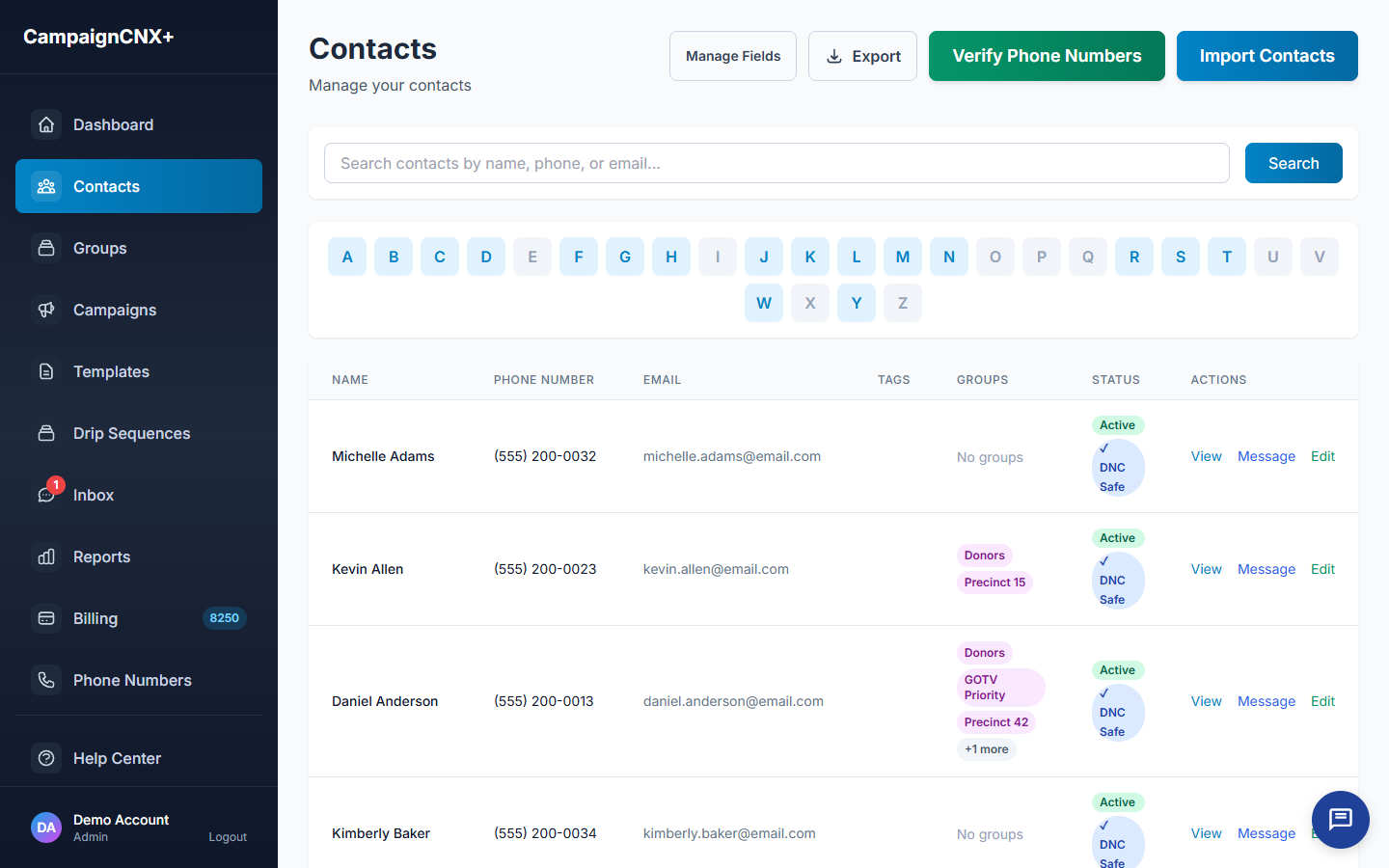
- Sort contacts with tags and groups. For example, tag volunteers "2026 volunteer" and put the people you will keep texting in a "Stay in touch" group. Messages are sent to groups.
- Record consent in a custom field. Store each person's consent date and source, such as "fall canvass sign-up sheet" or "website form."
- Schedule the thank-you and the "staying in touch" text. Use merge fields such as first name. Texts send only between 8 a.m. and 9 p.m. in the recipient's time zone, so schedule inside that window.
- Let STOP, HELP and START take care of themselves. CampaignCNX+ handles those replies automatically, so a person who opted out does not receive the next text.
- Read the replies, some of which will be offers to help again. The shared inbox, an add-on at $12.49 a month that is included on Enterprise, lets you and your team members answer them (staffers see the inbox once you allow it).
- Plan a light schedule for the off year. Scheduled and repeating texts suit a few planned messages a year. Pay-as-you-go texting is $0.06 per SMS segment, and the credits never expire.
For the full setup from the beginning, including registration and consent wording, see how to text voters. For the consent rules in more detail, see our page on texting with consent.
A short checklist
How a new number gets approved
- Open your account100 free SMS included
- Buy your number$5 a month. Nothing sends until the account has one.
- Verify your campaignCampaign Verify, $95 per two-year cycle. Needs your committee's EIN and filing.
- We file the registrationToll-free verification, or 10DLC for a local number ($75 one time)
- The carriers review itAbout three business days for a toll-free number
- Send your first textStart with a small test group
- Thank-you texts sent only to opted-in supporters and volunteers, between 8 a.m. and 9 p.m.
- Every contact sorted, with a consent date and source for everyone you keep texting.
- A written decision: keep the list active, archive it, or help supporters move to another organization.
- The opt-out list kept with the contacts, wherever they go.
- Volunteers debriefed and asked how they want to stay involved.
- Campaign Verify expiration checked, and a closing committee's obligations confirmed with its election authority.
Keep in touch with the people who helped
If your campaign or organization will stay in touch with its supporters, CampaignCNX+ keeps the list sorted by tags and groups, sends only within quiet hours and handles STOP replies for you. 100 free SMS included. Your number is $5 a month. Start a trial and schedule your first thank-you text.