
To keep supporters engaged between elections, give them a reason to hear from you a few times a season and something real to do a few times a year. In practice, that means a short, predictable rhythm of texts, for example one or two a month, each with a date, an event or a clear way to help. Add a handful of in-person events across the year, such as a volunteer thank-you, a training night, a service day and an information session for people thinking about running for office. Tell people what to expect, keep to it, and text only people who agreed to receive your texts.
The off year matters because the next campaign starts with the people who are still in touch. If a list hears nothing for a year, many of the people on it may not remember signing up, and the first text of the next campaign can come as a surprise. This guide gives an example calendar, events that suit the months between elections, and ready-to-copy texts under 160 characters. It is written for campaigns, local party organizations and community groups of any affiliation. For the full guide to campaign texting, see our political texting page.
Before you start: who you may text
Everything in this guide assumes that the people you text agreed in writing to receive texts from your organization, and that you recorded the date and the source. A sign-in or petition sheet counts only if it says so plainly and the date is recorded. A voter list, a walk list or the people you met at the doors this fall are not a texting list.
Two more rules carry over from the campaign:
- STOP stays in force. Anyone who opted out stays out, unless they text START to rejoin.
- Send what people signed up for. If your sign-up promised updates from a candidate's campaign, the off-year texts should come from that campaign and stay close to that purpose.
If you have not sorted your list since the election, start with our guide to what to do with your supporter list and volunteers after the election.
How often to text
There is no single right frequency, and we know of no reliable published figure for one. Base yours on what you told people when they signed up and on what your team can keep up.
Example (a starting point, not a rule): one or two planned texts a month, plus a reminder the day before any event a person said they would attend. In a busy month, such as a local election season, you might send a few more. In a quiet month, one text is enough, and skipping a month with nothing to say is better than sending a text with no purpose.
Watch your own replies and opt-outs. If STOP replies rise after a certain kind of message, send fewer of that kind. If people reply with questions and offers to help, the texts are useful to them.
An example off-year calendar
Every area's calendar is different. Some states hold local elections in the spring of odd-numbered years, some in the fall, and some in both. Ask your election authority for your 2027 dates and fill them in. The seasons below are an example.
| Season | Focus | Example texts and events |
|---|---|---|
| November to December | Thanks and a short pause | A thank-you text, a volunteer thank-you gathering, a "what to expect" text |
| January to March | Planning and spring local races | An annual meeting, a candidate information session, election reminders where spring races are held |
| April to June | Skills and service | A canvassing or petition training night, a community service day |
| July to August | Being visible | A booth or walking group at a summer festival or parade, a picnic |
| September to October | Fall local races and voter help | Registration reminders, election reminders where fall races are held, election worker recruiting |
| November | One year on | A short thank-you for staying in touch, and a look ahead to 2028 |
Events that work between elections

Texts keep people informed, and events keep them involved. A small organization can run each of these with a few volunteers.
- A volunteer thank-you gathering. Coffee, a potluck or an evening at a local restaurant. Keep it social, with a few minutes on the year ahead.
- A public meeting night. Attend a city council, county board or school board meeting together, and talk about it afterward. Supporters see how local decisions are made, which is useful for anyone who might run for office later.
- A training night. Teach door knocking, petition circulating or answering texts in a shared inbox (an add-on at $12.49 a month, included on Enterprise), so new volunteers are ready before the next campaign.
- A community service day. A park cleanup or a food drive gives people a reason to come out that has nothing to do with an election.
- A candidate information session. An evening for people thinking about running in the next local races. Our guide to recruiting candidates for the 2027 local races covers how to plan one.
- A listening round at the doors. Volunteers knock on doors to ask neighbors what matters to them, without asking for anything. Beacon's guide to running a listening canvass explains how to plan one. Beacon is a separate door-to-door canvassing product.
Ready-to-copy texts
Each text below is under 160 characters as written. Replace the bracketed placeholders, then count the characters again, because long names and links add length. The first text a person receives after a long pause should say who is texting and end with "Reply STOP to opt out."
Where a text asks for a reply, it uses a word such as GOING, MEET or TRAIN. Avoid asking people to reply YES. In CampaignCNX+, YES is a default opt-in word (along with START), so a YES reply is treated as an opt-in.
Reintroducing yourself after a pause
Hi [First name], it's [Name] with [Organization]. We'll text a few times a month about local events and ways to help. Reply STOP to opt out.
[First name], it's [Organization]. It's been a while. Our next volunteer meetup is [day] at [place]. Hope to see you. Reply STOP to opt out.
Thanks
[First name], thank you for standing with [Organization] this year. We're planning for next year and will be in touch soon.
[First name], a year ago you joined [Organization]. Thank you for staying with us. More soon about the year ahead.
Event invitations and reminders
[Organization] volunteer thank-you: [day], [time] at [place]. Bring a friend. Reply GOING so we plan enough food.
Reminder from [Organization]: our thank-you gathering is tomorrow at [time], [place]. See you there, [First name].
[Organization] annual meeting: [day] at [time], [place]. We'll set our plans for the year. Everyone is welcome.
Public meetings

[First name], the [City] council meets [day] at [time]. A few of us are going together. Reply MEET and we'll save you a seat.
[Organization]: The [School district] board meets [day] at [time]. The agenda is posted here: [link]. Join us if you can.
Training and service
[Organization]: Learn to knock doors before the next campaign. Training night [day], [time], [place]. Reply TRAIN to save a spot.
[Organization] park cleanup: [day], [time] at [park]. Gloves provided. Reply CLEAN if you can come.
Candidate information session
[Organization]: Thinking about running for local office? Info night [day], [time], [place], with local officials. Reply RUN for details.
Asking what matters
[First name], what should [Organization] focus on this year? Reply ROADS, SCHOOLS, PARKS, SAFETY or OTHER.
Thanks, [First name]. We'll share what we heard at our [month] meeting. Want the details? Reply MEET.
Voter help
[Organization]: Moved this year? Check that your voter registration has your current address before the [month] election: [official link]
[First name], [County] is recruiting election workers for the [month] election. Details from the county: [official link]
Local election reminders
[First name], [City] elects its council on [date]. Voting times and places from the county: [official link]
Tomorrow is election day in [City]. Find your polling place here: [official link]. Thank you, [Organization]
Annual check-in
[First name], you're on [Organization]'s text list. We send about [number] texts a month. Reply STOP anytime to opt out.
For more wording written for campaign season itself, see our 25 campaign text templates for local races.
What not to send between elections
- Texts to anyone who did not agree to receive them, however friendly the message.
- Messages that look as if they come from an election office. Name your organization in the text, and link to the official source for dates, registration and polling places.
- Texts about unrelated causes, or another organization's messages, unless your sign-up wording clearly covered them.
- Messages outside 8 a.m. to 9 p.m. in the recipient's time zone.
- Texts with nothing to say. If there is no event, request or useful date this month, skip the month.
Running the rhythm in CampaignCNX+
- Sort by interest. Use tags and groups for interests such as "training," "public meetings" or "service days," and custom fields for each person's consent date and source. Messages are sent to groups, so a training invitation can go only to the people who asked about training.
- Schedule the season at once. Write a season's texts in one sitting and schedule each for the day it should arrive. Repeating texts suit a standing monthly meeting.
- Welcome new sign-ups with a drip. A drip sequence (a series of texts sent on a schedule) can welcome people who join at a summer event: a welcome text, then a note about the next training a few days later.
- Collect sign-ups at events with a keyword. A person who texts a keyword such as JOIN to your number is asking for your texts, so set the keyword's reply to say who you are, what they will get and how to stop (reply STOP). Keywords are an add-on at $20 a month.
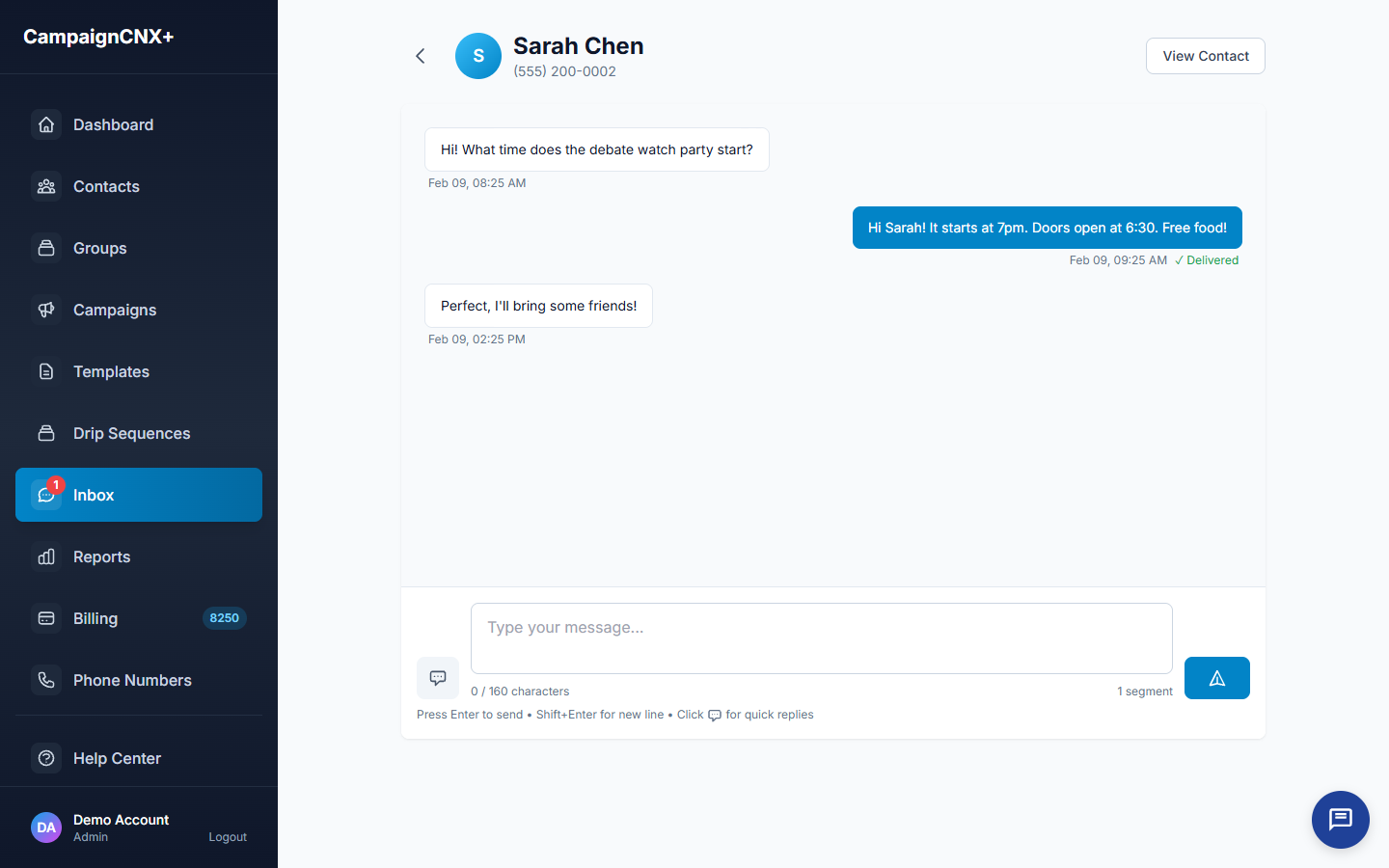
- Answer replies. Replies such as GOING or MEET arrive in the shared inbox, where you and your team members can answer them (staffers see the inbox once you allow it). The inbox is an add-on at $12.49 a month and is included on the Enterprise plan.
- Use pictures sparingly. An event flyer can go out as an MMS (a picture message), which uses 3 credits.
- Leave quiet hours and STOP to the system. Texts send only between 8 a.m. and 9 p.m. in the recipient's time zone, and STOP, HELP and START replies are handled automatically.
The costs suit a light schedule. Pay-as-you-go texting is $0.06 per SMS segment, and pay-as-you-go credits never expire. On monthly plans, which start with Basic at $55 a month for 1,000 texts, unused plan texts roll over.
If your organization texts as a political committee, check when its Campaign Verify token expires. Campaign Verify is the check that confirms to the carriers (the mobile phone companies) that a political sender is a real campaign. A request made before Sunday, November 15, 2026 expires on Sunday, January 31, 2027. A request made on or after that date lasts until Wednesday, January 31, 2029, which covers the 2027 local races and the 2028 elections. For more on scheduled and repeating texts, see our page on text message automation.
A short checklist for the year
How a new number gets approved
- Open your account100 free SMS included
- Buy your number$5 a month. Nothing sends until the account has one.
- Verify your campaignCampaign Verify, $95 per two-year cycle. Needs your committee's EIN and filing.
- We file the registrationToll-free verification, or 10DLC for a local number ($75 one time)
- The carriers review itAbout three business days for a toll-free number
- Send your first textStart with a small test group
- Every person on the list agreed to texts, with a date and source recorded.
- A "what to expect" text sent, and the promised frequency kept.
- A calendar for the year with your area's 2027 election dates filled in.
- Three or four in-person events planned, each with a reminder text.
- Reply words chosen for each request, never YES.
- STOP replies and plain-language opt-outs honored.
- Campaign Verify expiration checked before January.
Plan the year now
The weeks after an election are a good time to set the year's rhythm, while supporters still remember the campaign. Start a trial of CampaignCNX+, sort your opted-in supporters by interest and schedule your first season of texts. 100 free SMS included. Your number is $5 a month.